Why Online Casino Players Are Leaving Faster Than Ever


Recommended casinos
Across CasinoRank’s dataset, one pattern appeared repeatedly over the past 18 months. Platforms that introduced additional layers between app open and first gameplay consistently saw higher early-session abandonment, even when overall session frequency increased.
In multiple cases observed across European and Latin American operators, time-to-first-action increased while engagement frequency rose. Players opened apps more often, but a growing share exited before placing a bet. Where friction was introduced early in the session, retention declined despite higher traffic.
This pattern was not limited to a single operator, market, or feature type. It appeared across personalization layers, lobby restructuring, promotional overlays, and navigation changes that delayed the first meaningful interaction.
This behavior is now visible at scale.
These findings form the basis of CasinoRank’s latest industry briefing on the online casino attention crisis.
CasinoRank analyzed aggregated session data from 847 slot, crash, and live dealer titles across 40 regulated operators in Europe, Latin America, and Asia between Q2 2024 and December 2025, revealing a structural shift in player behavior that threatens traditional engagement models.
The core finding: Online casino gaming is experiencing an attention crisis. Sessions are fracturing into shorter, higher-frequency bursts, and platforms have seconds, not minutes, to earn engagement.
The data is unambiguous. Session frequency increased 23% year over year, while median session duration dropped 18%. Players are not playing less. They are playing differently. And operators who fail to adapt are bleeding retention in real time.

This chart shows how session frequency and median session duration moved in opposite directions over the past 18 months. Players are returning more often, but spending less time per visit.
The Attention Crisis: What the Data Actually Shows
"Attention crisis" is not industry hyperbole. It describes a measurable, accelerating pattern identified across multiple markets and formats in CasinoRank's research.
Three structural changes define the crisis:
1. Players return more often but commit less time per visit
CasinoRank’s tracking shows average daily sessions per player increased between Q4 2024 and Q4 2025. In the same period, median session duration fell.
This is not reduced engagement. It is a redistributed engagement. Players treat casino apps like social media: always available, accessed in bursts, abandoned and re-entered throughout the day.
2. The window to earn engagement has collapsed to seconds
CasinoRank’s "Weekend Effect" study, which compared weekend versus weekday behavior patterns, found that weekend sessions have historically been shorter but more goal-driven. Players logged in, acted quickly, and left with minimal browsing.
That weekend's behavior is now the baseline. Weekday sessions increasingly mirror weekend patterns in speed, brevity, and reduced exploration. What operators once considered "peak behavior" has become standard player expectation every day of the week.
The implication: platforms no longer have the luxury of gradual onboarding. They must deliver value immediately or lose the session.
3. Mobile eliminated the penalty for leaving
On a desktop, closing a casino session required a deliberate action. On mobile, exiting is reflexive. A single swipe ends the session, and re-entry is just as effortless.
CasinoRank’s mobile-focused analysis shows this has fundamentally changed player tolerance for friction. When leaving costs nothing, players leave constantly. They scan lobbies in seconds, make instant decisions, and abandon anything that feels slow, cluttered, or unclear.
This creates what CasinoRank calls the "attention tax." Every additional second of delay between app open and meaningful action costs exponentially more engagement.

This chart shows how session retention declines as response latency increases. Engagement drops sharply once delays extend into double-digit seconds.
Dylan Thomas, Credibility Lead at CasinoRank, explained the shift, saying:
"Engagement is not falling. It is fracturing. Players are returning more often, but they are committing less time per visit, and platforms now have seconds, not minutes, to earn the first meaningful action."
The 2026 Operator Playbook: How to Win the Attention War
The operators outperforming in retention and frequency metrics in CasinoRank's data share five strategic adaptations. These are not theoretical recommendations. They are observable behaviors separating winners from losers.
1. Optimize Time to First Meaningful Action, Like Revenue Depends On It (It Does)
Every second between app open and first spin, first bet, or first interaction is a leak point. CasinoRank's benchmarking shows that leading platforms achieve the first action within 8 seconds in 68% of sessions. Lagging platforms average 15+ seconds and lose most users before engagement begins.
Optimization targets:
- Lobby load speed (target: under 2 seconds)
- Navigation depth (target: 1-2 taps maximum from open to gameplay)
- Game initialization time (target: under 5 seconds)
- Elimination of interstitials, pop-ups, and login friction
Dylan Thomas: "In 2026, the biggest competitive advantage is not a bigger game library. It is a faster path from opening the app to doing something that feels rewarding."
2. Treat Simplicity as a Performance Strategy, Not an Aesthetic Choice
Complexity is no longer a differentiator. In attention-scarce markets, it is a tax.
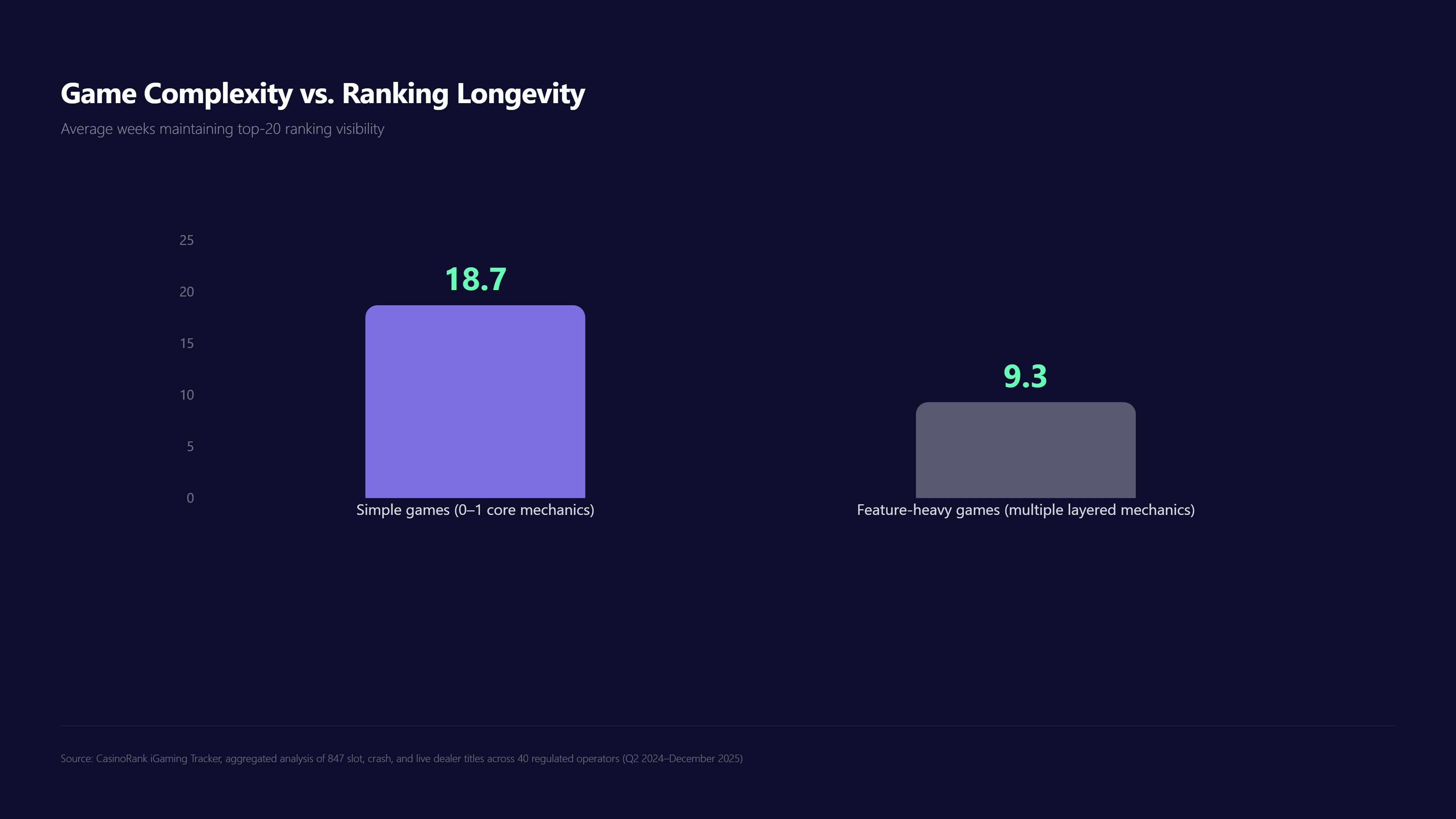
This chart compares how long simple and feature-heavy games remain visible in the top-20 rankings. Games with fewer mechanics maintain ranking positions for significantly longer periods.
Games and lobbies that communicate instantly outperform those requiring explanation. This does not mean dumbing down content. It means compressing communication.
Winning games in CasinoRank's data share three traits:
- Core mechanics are visually obvious within the first screen
- First meaningful outcome or reward occurs within 10 seconds
- UI elements are familiar, not innovative
Feature-heavy mechanics, nested menus, unclear CTAs, and ambiguous previews all slow decision-making. Slower decisions become exits.
3. Anchor Lobbies with Recognition, Rotate New Content Strategically
Players want familiar entry points. CasinoRank's data shows lobbies that anchor with high-recognition titles and rotate novelty in controlled zones outperform full-rotation strategies.
The balance matters:
- Too much novelty creates decision paralysis
- Too much repetition creates stagnation
- The winning approach: anchored flexibility
In an attention-scarce environment, anchors are not boring. They are infrastructure. A constantly changing lobby forces players to re-learn navigation and re-assess options. A lobby with stable, recognizable anchors reduces cognitive load and allows exploration without disorientation.
4. Measure Engagement Differently Than You Did in 2025
Session length alone misleads. In attention-scarce markets, the metrics that reveal whether attention is earned or rented are frequency-based and friction-focused.
Key metrics for 2026:
- Session frequency and re-entry patterns show how often players return within a day or week.
- Time to first action, measuring how quickly players move from opening the app to starting gameplay.
- Game-switching behavior indicates whether players stay engaged or exit after a brief interaction.
- Drop-off point analysis highlighting where sessions end, whether in the lobby, during game loading, or shortly after play begins.
- Recognition versus discovery ratios reflect whether players favor familiar titles or try new ones.
Operators that shift their measurement frameworks toward these metrics will spot retention risks earlier and optimize more quickly than competitors still focused on session duration.
The Prediction: Who Wins and Who Loses in 2026
Based on 18 months of tracking data and current trajectory analysis, CasinoRank expects the attention crisis to accelerate through 2026 rather than stabilize.
- Winners: Operators who treat attention as a finite, measurable resource and design around speed, clarity, and repeatable re-entry. Platforms that achieve sub-8-second time-to-action and anchor lobbies with high-recognition content will widen retention gaps.
- Losers: Operators who continue optimizing for session length, content volume, and feature complexity. Platforms that ignore micro-session behavior will see compounding retention losses as players migrate to faster alternatives.

This visualization shows how player sessions drop off at each stage of the online casino journey, from app open to first meaningful action. The largest losses occur before gameplay begins, highlighting the impact of early-session friction.
The gap will widen faster than most operators expect. By Q4 2026, CasinoRank projects the retention difference between fast and slow platforms could reach 4x or higher. Operators who have not adapted by mid-year will face structural disadvantages that are difficult to reverse.
CasinoRank’s 2026 Outlook
Looking at how player behavior has changed over the past 18 months, a few things are likely to play out in 2026.
First, not every operator will make it. In crowded European markets, some mid-tier platforms are already struggling to keep pace. Older, desktop-first setups are slower to adapt, and as retention gaps grow, the cost of replacing lost players rises quickly. For some, consolidation or exit will become the only realistic option.
Second, the way engagement is talked about is likely to change. Session length on its own is no longer telling the full story. Players are coming back more often, but for shorter periods. As that becomes more obvious, session frequency is likely to feature more prominently in how operators discuss performance and growth.
Third, regulators are starting to notice how play patterns are shifting. When players log in many times a day for short sessions, traditional time-based tools do not always capture what is really happening. In at least one major market, this could lead to trials of new approaches that focus more on frequency, alongside existing limits.
Conclusion: Speed Is Strategy, Friction Is Churn
The defining shift in online casino gaming entering 2026 is not that players are less interested. It is that attention is being allocated differently.
CasinoRank's 18-month analysis shows an industry moving toward shorter, faster, more frequent interactions driven by mobile behavior, infrastructure maturity, and the elimination of friction in leaving and returning.
That change is reshaping which games perform, which formats scale, and which operators maintain retention.
The winners in 2026 will not be the operators who add the most content, features, or innovation. They will be the ones who reduce effort, compress understanding, and make re-entry effortless.
In an attention-scarce market:
- Speed is strategy
- Clarity is retention
- Friction is churn
The data is clear. The crisis is measurable. The question is whether operators will adapt quickly enough to capture the opportunity or lose market share to competitors who already have.
CasinoRank will continue tracking early-session engagement metrics throughout 2026 to monitor how operators adapt to attention fragmentation.